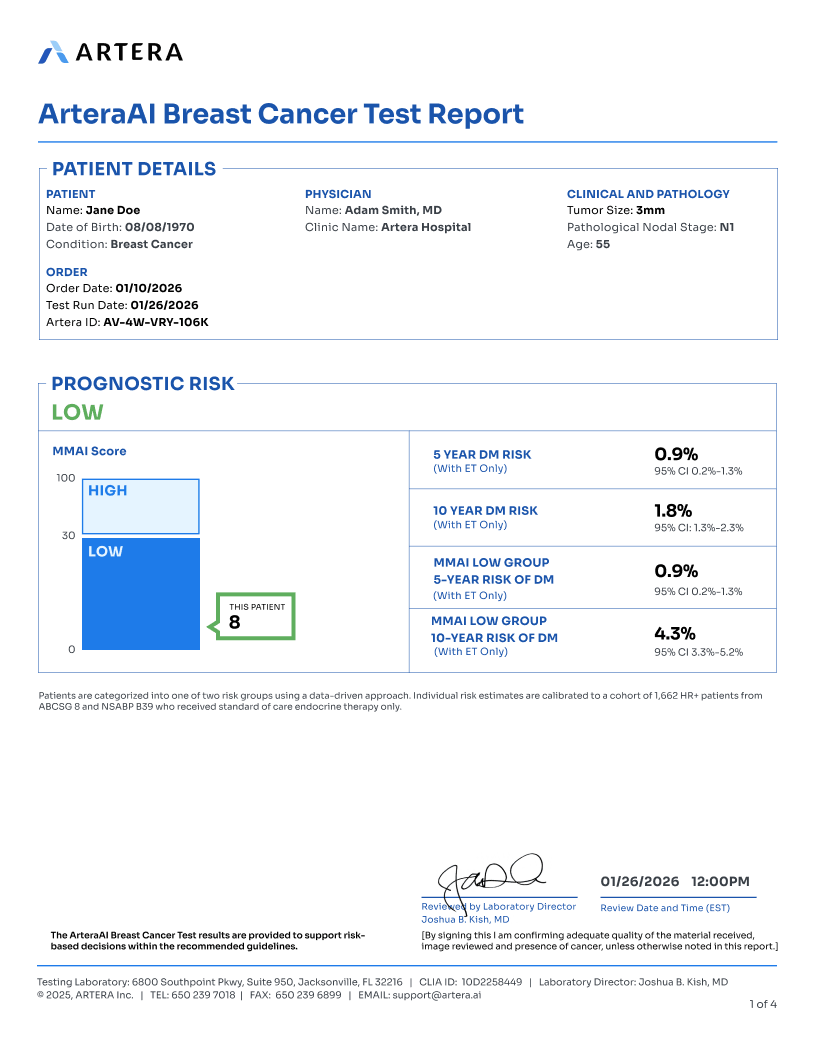
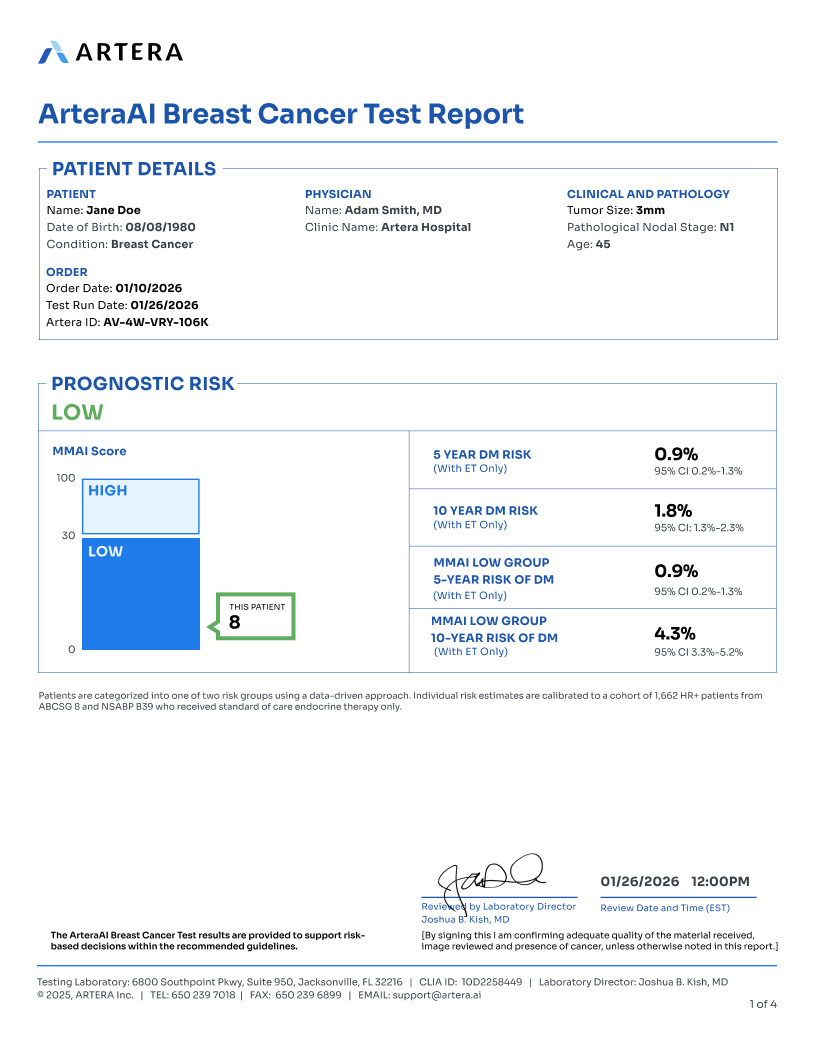
The MMAI Risk Group provides an assessment of the aggressiveness of the patient's breast cancer. In a validation dataset comprised of patients from NSABP B 14 and NSABP B 39, the MMAI categorized 68% and 32% of patients to MMAI low and high risk, respectively.¹ For patients who are 50 years old or older and node-negative, the risk group is also predictive of chemotherapy benefit.
MMAI Score
The MMAI Score, which spans from 1 to 100, quantifies recurrence risk along a continuous spectrum. Scores are rounded to the nearest integer. A patient with an MMAI score of 30 is considered high risk.
Individual Calibrated Risk
The 5- and 10-year risk estimates indicate an individual patient’s likelihood of developing distant metastasis, derived from a calibration cohort of NSABP B 39 and ABCSG 8 patients treated with standard of care endocrine therapy alone. These estimates can support more informed clinical decision-making.
Group Average
The group average risk of distant metastasis at 5- and 10-years are based on the rates observed for patients within the ABCSG 8 validation dataset.
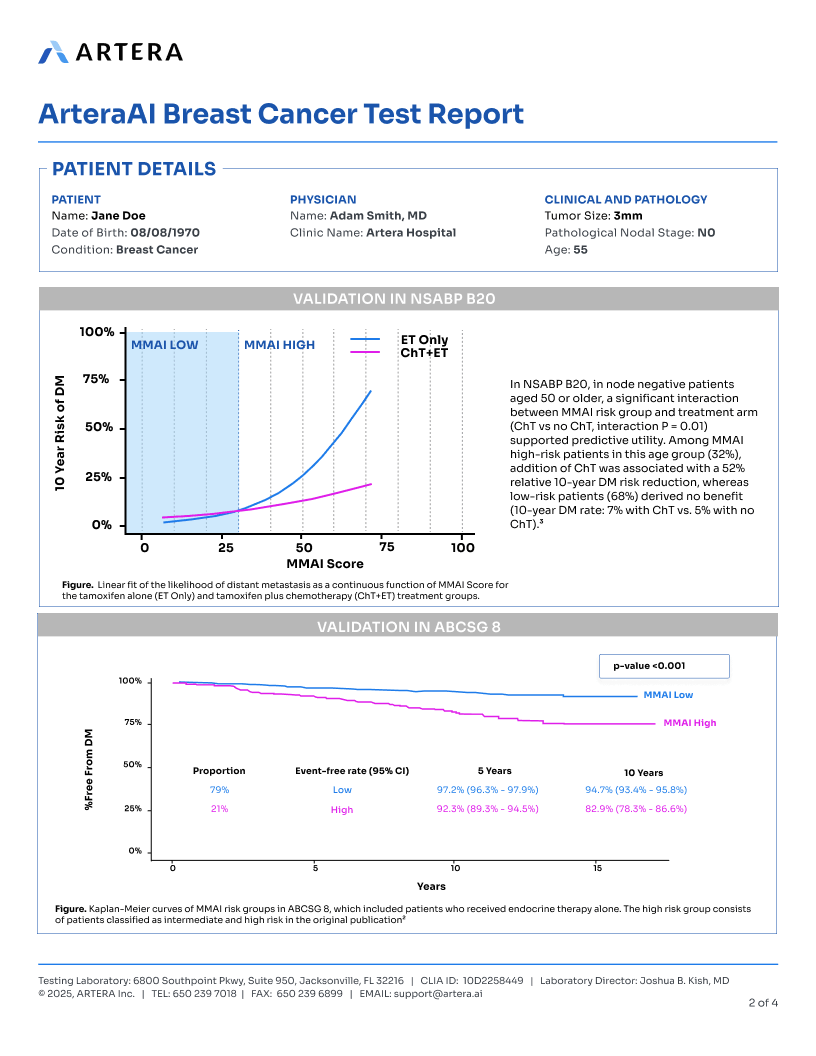
Chemotherapy Benefit
The curves in this figure illustrate the predicted risk of distant metastasis across the MMAI Score range, comparing outcomes with and without chemotherapy. This visualization is to aid in assessing whether the anticipated benefit of chemotherapy is large enough to justify treatment escalation. For ease of interpretation, the graph is labeled in 10-point MMAI Score increments, and a MMAI Score of 30 marks the threshold between low- and high-risk groups.3 The risk estimates are based on patients from the NSABP B 20 trial, which evaluated the added benefit of chemotherapy alongside tamoxifen in women with node-negative, HR-positive breast cancer.
Supporting Prognostic Information
Kaplan–Meier curves from the ABCSG 8 trial, which evaluated adjuvant endocrine therapy strategies in postmenopausal women with low-risk, node negative and node positive, HR-positive early breast cancer, provide a visual tool to support discussions about prognosis and treatment planning. These curves for MMAI low and high risk patients illustrate how the risk of distant metastasis changes over time for patients in each risk group. In this report, the MMAI high-risk group includes the pre-specified intermediate- and high-risk categories defined in the original publication.2
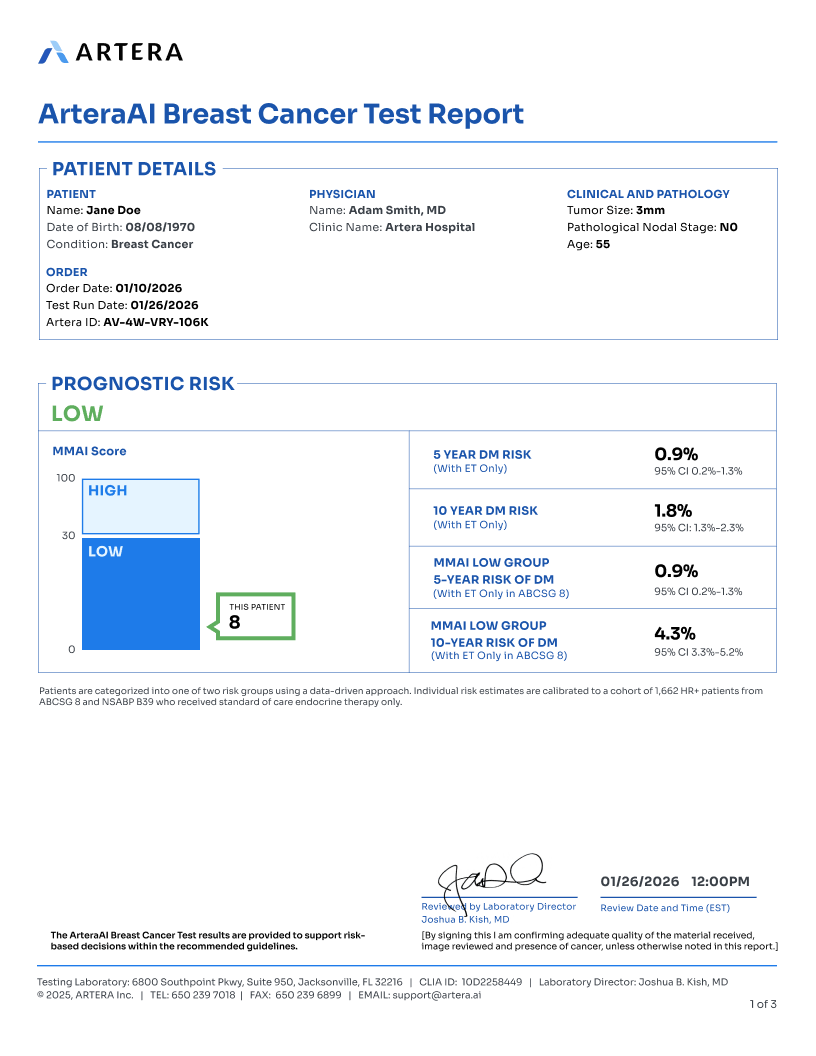
The MMAI Risk Group provides an assessment of the aggressiveness of the patient's breast cancer. In a validation dataset comprised of patients from NSABP B 14 and NSABP B 39, the MMAI categorized 68% and 32% of patients to MMAI low and high risk, respectively.¹
MMAI Score
The MMAI Score, which spans from 1 to 100, quantifies recurrence risk along a continuous spectrum. Scores are rounded to the nearest integer. A patient with an MMAI score of ≥ 30 is considered high risk.
Individual Calibrated Risk
The 5- and 10-year risk estimates indicate an individual patient’s likelihood of developing distant metastasis, derived from a calibration cohort of NSABP B 39 and ABCSG 8 patients treated with standard of care endocrine therapy alone. These estimates can support more informed clinical decision-making.
Group Average
The group average risk of distant metastasis at 5- and 10-years are based on the rates observed for patients within the ABCSG 8 validation dataset.
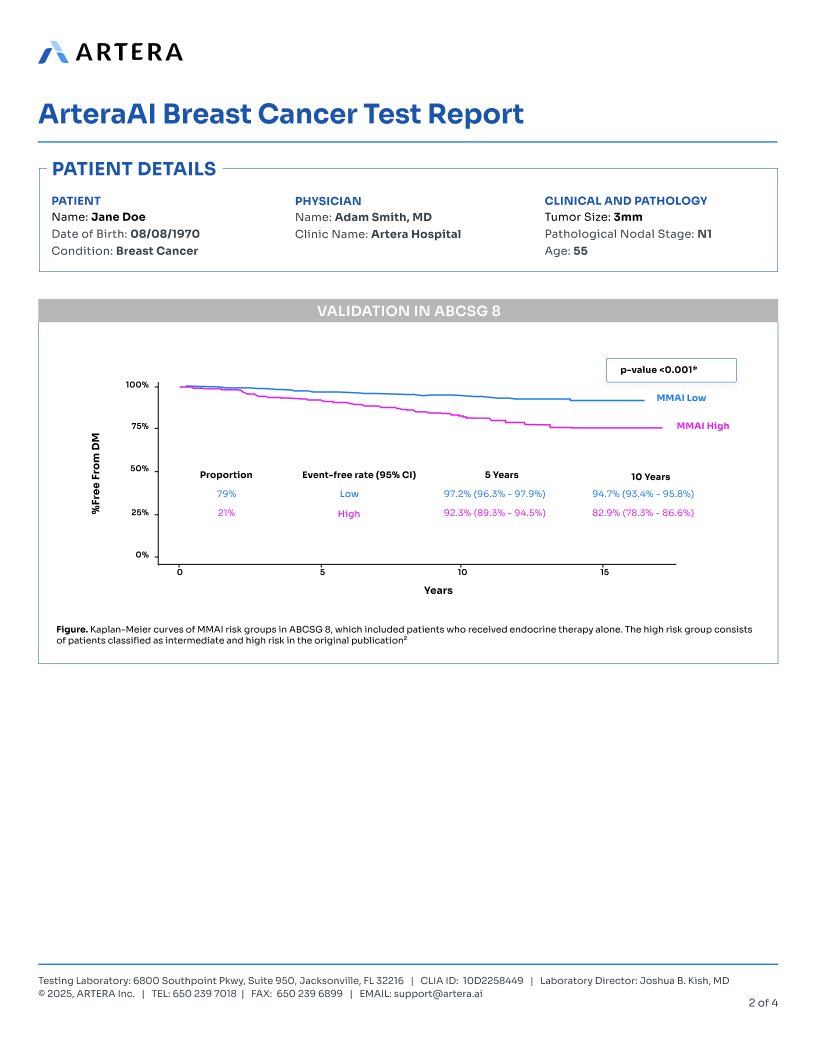
Supporting Prognostic Information
Kaplan–Meier curves from the ABCSG 8 trial, which evaluated adjuvant endocrine therapy strategies in postmenopausal women with low-risk, node negative and node positive, HR-positive early breast cancer, provide a visual tool to support discussions about prognosis and treatment planning. These curves for MMAI low and high risk patients illustrate how the risk of distant metastasis changes over time for patients in each risk group. In this report, the MMAI high-risk group includes the pre-specified intermediate- and high-risk categories defined in the original publication.2
The MMAI Risk Group provides an assessment of the aggressiveness of the patient's breast cancer. In a validation dataset comprised of patients from NSABP B 14 and NSABP B 39, the MMAI categorized 68% and 32% of patients to MMAI low and high risk, respectively.¹
MMAI Score
The MMAI Score, which spans from 1 to 100, quantifies recurrence risk along a continuous spectrum.Scores are rounded to the nearest integer. A patient with an MMAI score of ≥ 30 is considered high risk.
Individual Calibrated Risk
The 5- and 10-year risk estimates indicate an individual patient’s likelihood of developing distant metastasis, derived from a calibration cohort of NSABP B 39 and ABCSG 8 patients treated with standard of care endocrine therapy alone. These estimates can support more informed clinical decision-making
Group Average
The group average risk of distant metastasis at 5- and 10-years are based on the rates observed for patients within the ABCSG 8 validation dataset.